
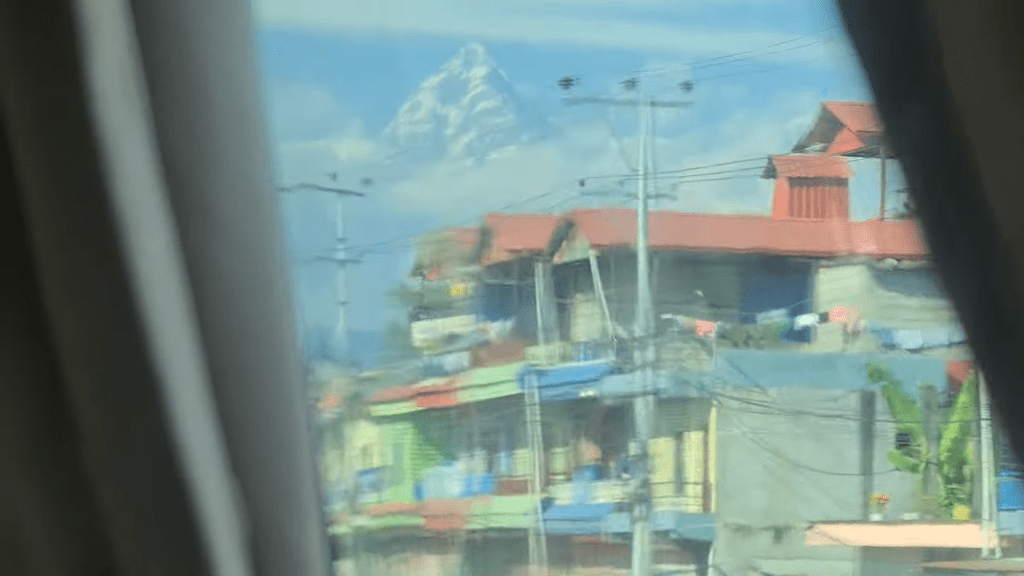
I. Pathos
“Have you climbed the Eiger?”
“Excuse me?”
“I overheard you telling that guy that you are a climber.”
“Oh, no. I haven’t had the opportunity.”
“Is it too difficult for you?”
“Well… climbs like those require things to align. Why? Are you interested in climbing it yourself?”
“No, I only just started hiking and skiing.”
My conversationalist—a middle-aged man with whom I was sharing a bench seat on a bouncy bus ride from the Chitwan Jungle back to Kathmandu, where I was due to catch my flight home—reached into his pocket and took out his phone. He showed me a photograph of a little boy standing between his parents.
“Do you know who this is?” he asked.
“That’s David Lama when he was little,” I said. “He climbed this mountain here in Nepal—Lunag Ri. I went specifically to see it, and—”
“He is dead, you know, right?” he interrupted.
“Yes,” I said. “I know.”
“What about her?” He flipped through images like a card deck. “Do you know her?”
“No, I’m afraid I don’t.”
“A German athlete” he announced, almost thrilled by his own knowledge. “She was dying on a mountain this summer.”
“Unfortunately, accidents do happen in the mountains,” I said calmly.
“She did specify that she did not want anyone to risk their lives to save her,” he added, offering details I had not asked for.
I said nothing. He did not seem like a bad man, but I was grateful that none of my many friends lost in the mountains were famous enough to be turned into this kind of anecdotes.
II. Heights
Seven weeks had passed since I first arrived in Nepal. It was my first time in the Himalayas. By then, I had already been climbing for sixteen years, and I had been fantasising about coming here for even longer. Yet the time had never felt right. Excuses were always at hand: lack of money, lack of partners, lack of experience. Only later did I understand that what truly held me back was fear—not of the mountains, but of my own indifference to my wellbeing.
I worried that my inner fire, in combination with the bigger wilderness, might tip into fatal recklessness. Still, I kept going to the Alps, the Scottish hills, Africa, Norway—anywhere I could. Over time, I learned to listen to the mountains and to discipline my energy. Occasionally, I climbed and skied alone. I have a deep need to be one-on-one with nature and the unknown. On those solitary trips, completely free, I learned to make choices with those who love me in mind. Eventually, I felt I had reached a kind of maturity—an internal quiet—that made me ready for the Himalayas.
As so often, I couldn’t find a climbing partner willing to go at the same time. So I let go of any pressure to summit and bought a plane ticket to Nepal.
In Kathmandu, I sorted my permits for entering the Khumbu and Rolwaling valleys. I decided to go to Khumbu first, intending to follow the Everest Base Camp trail. Friends told me it was well frequented, which I thought might be an advantage: easier logistics, a measure of safety while I learned the terrain. But once I realised how easy and safe travelling in Nepal actually was, the crowds—though sometimes entertaining—became an inconvenience.
It wasn’t their number. There were fewer than usual, due to recent floods and protests that had delayed or cancelled many groups. It was the repetition and the tone of their questions.
“No guide? No porter?”
“Alone?”
“You know it’s not allowed to climb without a permit?”
I wasn’t breaking any laws. I had done my homework. And yet there is no law requiring me to justify myself to every passer-by. I understood their curiosity, but I felt pulled away from the experience of being there. I longed for privacy in my explorations. So I turned away from the popular itinerary. The route I chose had fewer people and demanded more physically, with one major drawback: it did not end at Everest Base Camp. Try explaining the purpose of such an aimless journey to friends and family back home.
What that valley did have, though, was Lunag Ri—the mountain David Lama climbed solo. In photographs, it looked so arresting that I was willing to travel there just to stand beneath it.
After three days of gaining altitude, the main trail simply ended. Beyond the last village, there was suddenly no one. The views did not disappoint; they summoned a sharp sense of purpose. Reaching Lunag felt like arriving somewhere sacred. The mountain was larger in reality, self-possessed, almost proud, and it demanded respect. As one experienced friend who helped me plan the trip said, “It’s all about what a place means to you.” This valley carried that meaning for me.
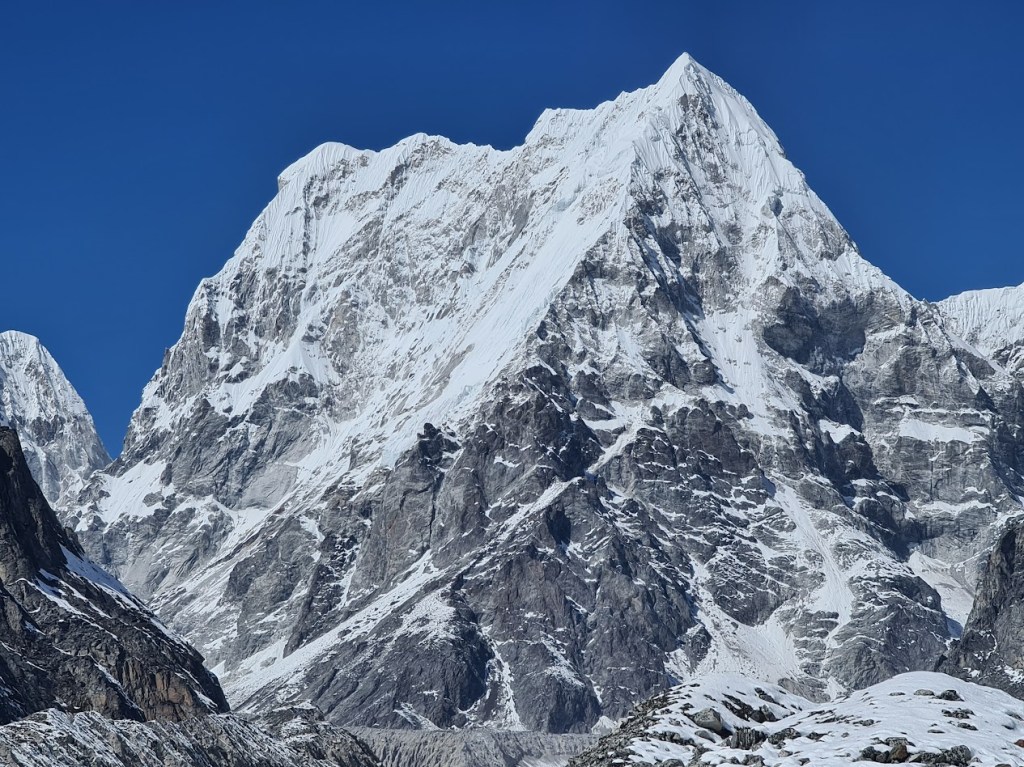
With my backpack full of what I needed, I felt freer than I had expected. It was time to decide how far I wanted to go. The horizon was crowded only with mountains, but I was looking for one that promised both pleasure and a safe return. I chose an appealing peak I estimated to be around 5,700 metres—by Himalayan standards, almost a hill. Still, I had never been that high, and I was acclimatised only to 4,800 metres.
I wanted to see how my body and mind would respond. The peak was steep enough to be engaging, yet gentle in terms of objective danger, and close enough to the nearest village that I could—if necessary—drag myself back after an injury. Its proximity also meant I could attempt it in a single day, without camping.
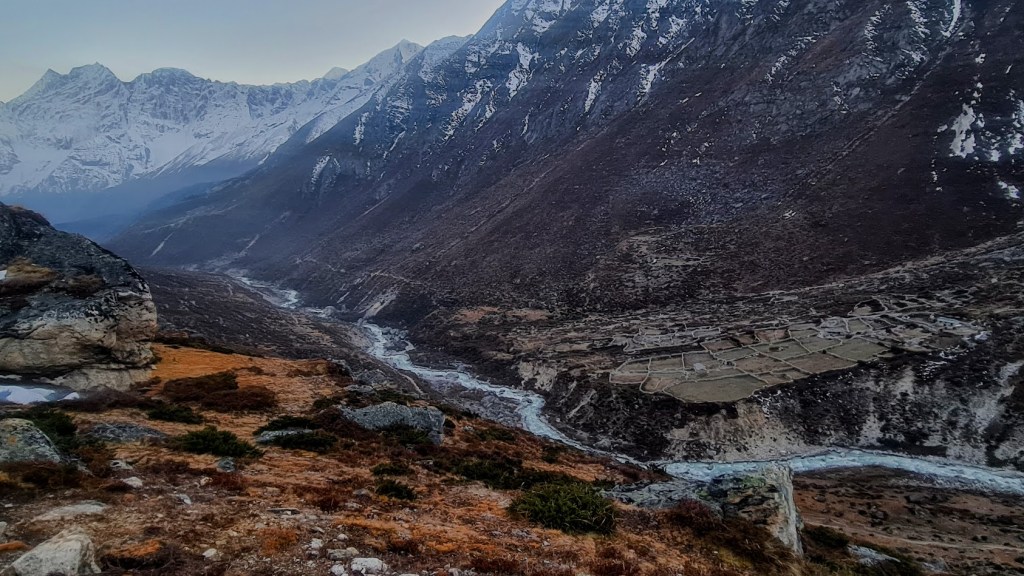
Starting from the village at 4,200 metres meant 1,500 metres of elevation gain—assuming I reached the top at all. The summit was rocky, and though a snow gully led upward, I couldn’t tell whether it continued all the way. I wasn’t even certain I could reach the mountain itself; between us lay a wide, roaring glacial river. What I could do was try.
I left Lughden village at 3:30 a.m., walking the easy ground in darkness. It had taken me nearly three hours the day before, and I hoped to reach the river by first light. The air was calm, the temperature mild. Unlike previous days, my legs felt light and my breath sustaining—my body had finally adjusted.
I reached the crossing I had scouted earlier. The river was wider there, and I hoped that meant shallower. I descended the steep bank. Dawn was breaking, but the muddy, churning water looked hostile. I tightened my muscles and stepped in.
The boulders were slick. I placed each boot deliberately, gripping my poles, planting them and pushing forward. I hadn’t prepared mentally for the sensation of water—my mind had rehearsed a battle on land. The water was simply… wet. I forced myself back into analysis. After crossing two gravel islands and wading thigh-deep for the third time, I reached the far bank.
Still warm from the approach, I didn’t change clothes and began climbing immediately. If I had to choose one word for the rest of that day, it would be quiet.
As I gained height, the sound of the river faded until it vanished entirely. No animals. Only shrubs brushing my legs, pebbles scraping underfoot, air moving in and out of my lungs. Morning soaked the highest peaks in honey-coloured light, deepening the shadows below. The place felt like an ageing painting, guarded by cold.
I stopped to change into my high-altitude boots and dry trousers, then carried on. The snow was perfect: firm enough to hold my weight, soft enough not to slip. It crunched pleasantly as I moved upward. Hours passed in a trance of motion, only pausing to put on my crampons, change my poles into ice axes, or adjust my layering. At some point, with my head down, axes and crampons biting into the snow, I became aware of the heat and the thinning air. As my nearly empty pack felt heavy, my head felt light. Still, I continued.
I climbed one narrowing, then another, until I reached a ledge beneath a vertical rock wall. It looked fragile. I had no gear to protect a fall. I searched for a way around, but the sun-rotted snow and the exposure felt lethal.
This is it, I thought. This is as far as I’m willing to go.
Only then did I fully register how far I was from any help already.
I was proud to recognise the moment to stop, yet aware that mountains are never fully predictable. Before leaving for Nepal, I had made an emergency plan, written my will, and informed family and friends. We like to believe it is entirely our choice when we go into the mountains, but we cannot prevent our decisions from affecting others. We can only hope that those we love would understand. I took out my InReach messenger and sent my emergency contact a check-in: I’m here. She would receive my exact location.
I ate a piece of my celebratory Bounty bar. It tasted exactly like childhood.
Satisfied, I looked around. There was more space, more mass, more mountain than my soul could hold at once. I felt that I had not only gone higher, but deeper—into the fabric of the universe itself.
Both my phone and my camera had died, so I couldn’t take a single photograph. That only deepened the moment’s singularity. Reaching that place required what mystics call letting go of attachment—even attachment to life itself. I did not want to die; I wanted to live fully. Pure, unrestrained existence, intimately connected to its source. Something like what the Dalai Lama described as “the invisible union of the realisation of emptiness and perfect awareness.”
Lost in these thoughts, in no hurry to descend, I received a message from my friend: Wahooooo! It said everything that needed to be said and pulled me gently back to earth.
I reached the village late that night—exhausted, exhilarated, safe.
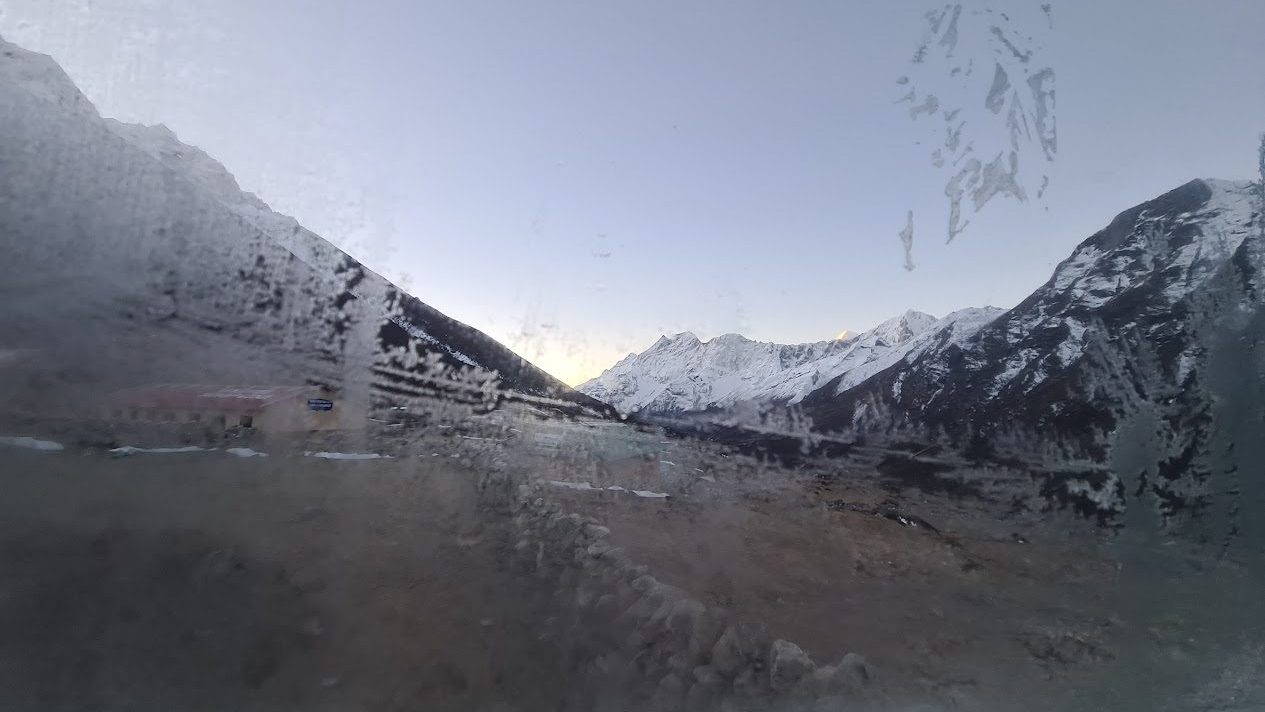
I returned from my seven weeks of further wandering around Nepal untouched. Others I met along the way were not as fortunate. Later, people asked me, How was your trip? What were the highlights? I struggled to answer. I only knew that the journey had changed me forever, just when I thought I had life figured out.
I can’t fully explain why. Partly because it was so many small things at once, and partly because I am bound to a promise of silence. But I do know this: by going so far alone, I feel closer to humans—to the untold stories carried in their eyes and in their smiles.

![How to Focus and When to Chaos [Part II]](https://suzanaelmassri.blog/wp-content/uploads/2025/04/20230716_083613.jpg?w=1024)
![How to Focus and When to Chaos [Part I]](https://suzanaelmassri.blog/wp-content/uploads/2025/02/20250112_141419.jpg?w=1024)
 suzanaelmassri.blog
Leave a comment